
Williams, C., Webster, J. M., Salles, T., Paumard, V., Grimaldi, C., & Lejri, M. (2026). Carbonate platform evolution in response to the Mid – Pleistocene climate transition on the North-West Shelf of Australia: Insights from forward stratigraphic modelling. Marine Geology, 493, Article 107716. https://doi.org/10.1016/j.margeo.2026.107716
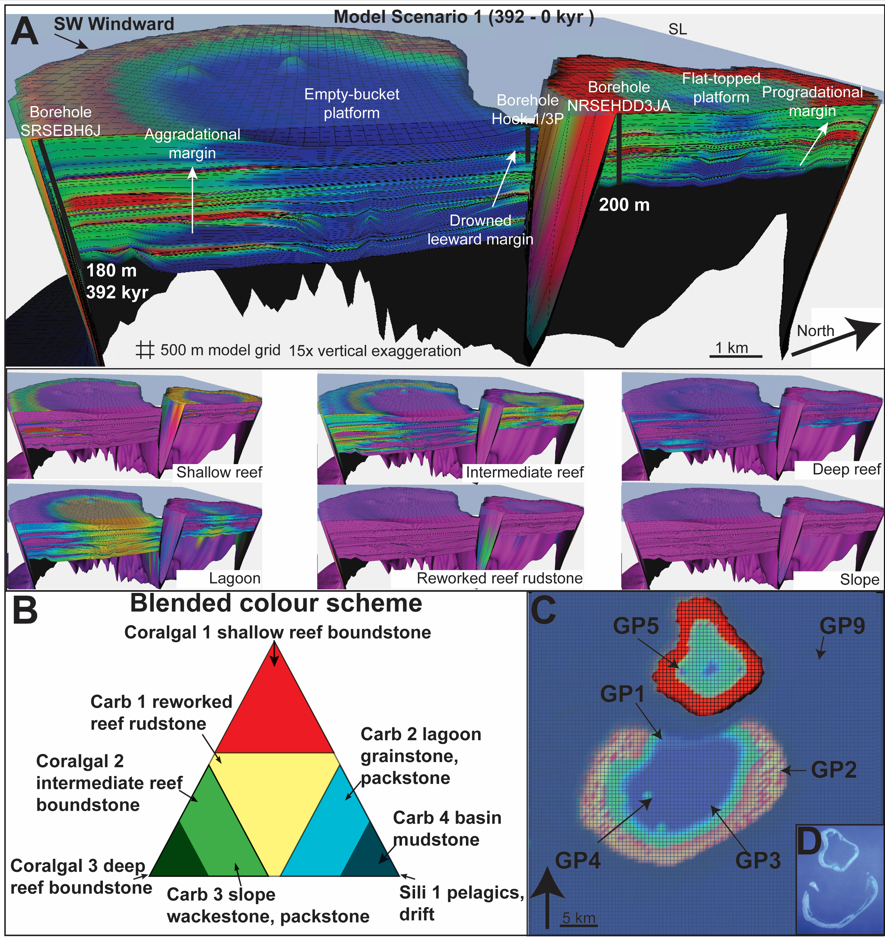
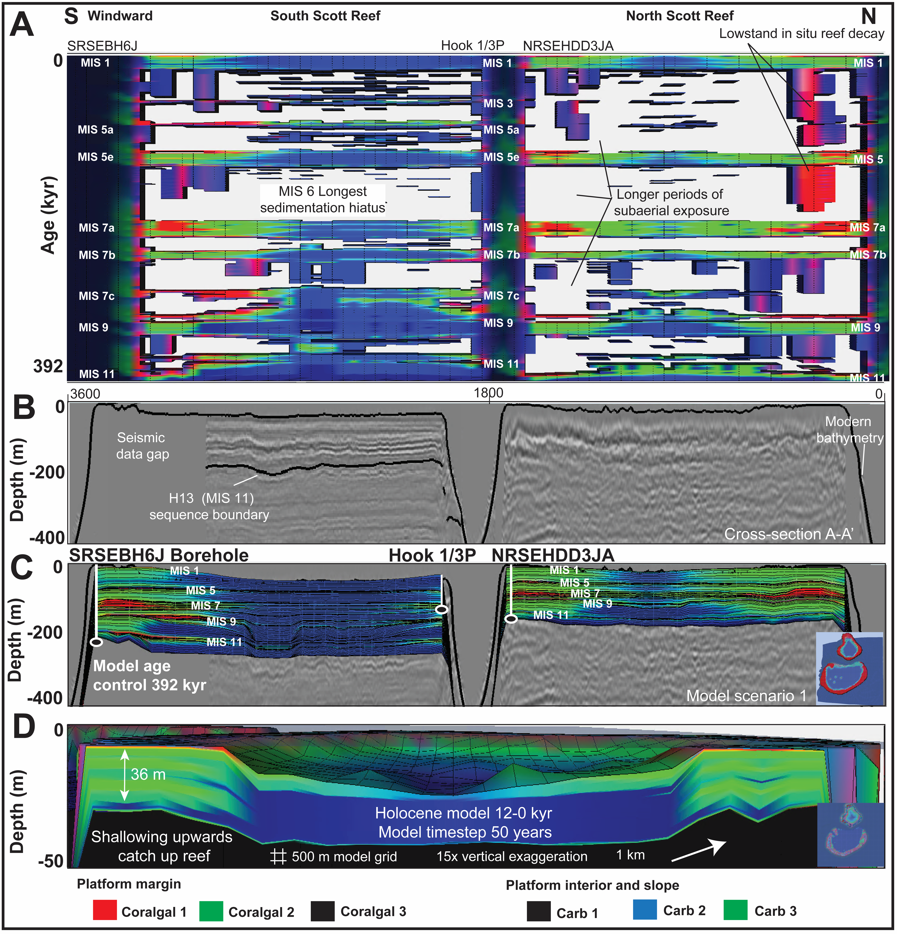
This paper reconstructs the Quaternary evolution of North and South Scott Reef using a data-calibrated forward stratigraphic modelling (FSM) approach. The primary objective is to quantify the response of these isolated carbonate platforms to increased sea-level amplitude and reduced periodicity associated with the Mid-Pleistocene Transition (MPT), and to evaluate mechanisms driving the partial drowning of the South Scott Reef leeward margin. The study integrates multibeam bathymetry, 3-D seismic data, sedimentary facies, U/Th chronology, and coralgal assemblages to calibrate a 3-D Petrel GPM (Geologic Process Model) model spanning 1.2 Ma to present. Sensitivity tests investigate the relative roles of subsidence, sea-level forcing, carbonate production, ecological depth thresholds, and wave energy in controlling platform architecture and facies patterns. A calibrated base-case model (392 kyr to present) reproduces the large-scale geomorphology of both platforms and is extended to 1.2 Ma to test the influence of hypothesised MPT-related environmental change. Trial-and-error style FSM is used to refine parameters controlling accommodation, sediment transport, carbonate production, and coralgal facies zonation. The resulting synthetic stratigraphy provides new quantitative insights into sequence development, lagoonal infilling, margin evolution, and facies variability across multiple glacial–interglacial cycles.
Scope: Quantitative reconstruction of the Quaternary evolution of the North and South Scott Reef carbonate platforms using data-calibrated forward stratigraphic modelling (FSM), spanning ~1.2 Ma to present.
Primary objective: Quantify reef response to increased sea-level amplitude and reduced periodicity across the Mid-Pleistocene Climate Transition (MPT), and investigate mechanisms driving partial drowning of the South Scott Reef leeward margin.
Data integration: Multibeam bathymetry, 3-D seismic interpretation, sedimentary facies, U–Th chronology, coral and coralline algal assemblages, and modern wave-energy and oceanographic datasets.
Modelling approach: Three-dimensional carbonate Geologic Process Modelling (GPM) in Petrel, calibrated using a base-case model (392 ka to present) and extended to 1.2 Ma through sensitivity testing.
Key results: Reef response to the MPT initiates during the MIS 12 lowstand, marked by prolonged subaerial exposure and karstification, followed by rapid aggradation during MIS 11 that establishes a persistent bucket-shaped platform morphology.
Sensitivity tests: Increased sea-level amplitude, wave energy, and time-variable carbonate production are required to reproduce observed stratigraphy; antecedent topography and subsidence exert first-order controls on platform architecture.
Platform drowning mechanism: Partial drowning of the South Scott Reef leeward margin is best explained by a reduction in carbonate production from ~0.5 Ma onward, likely linked to increased environmental stress from monsoonal intensification and episodic upwelling.
Broader significance: Demonstrates the value of FSM for reducing uncertainty in seismic interpretation and quantifying carbonate platform responses to long-term climatic and eustatic forcing during the Quaternary.
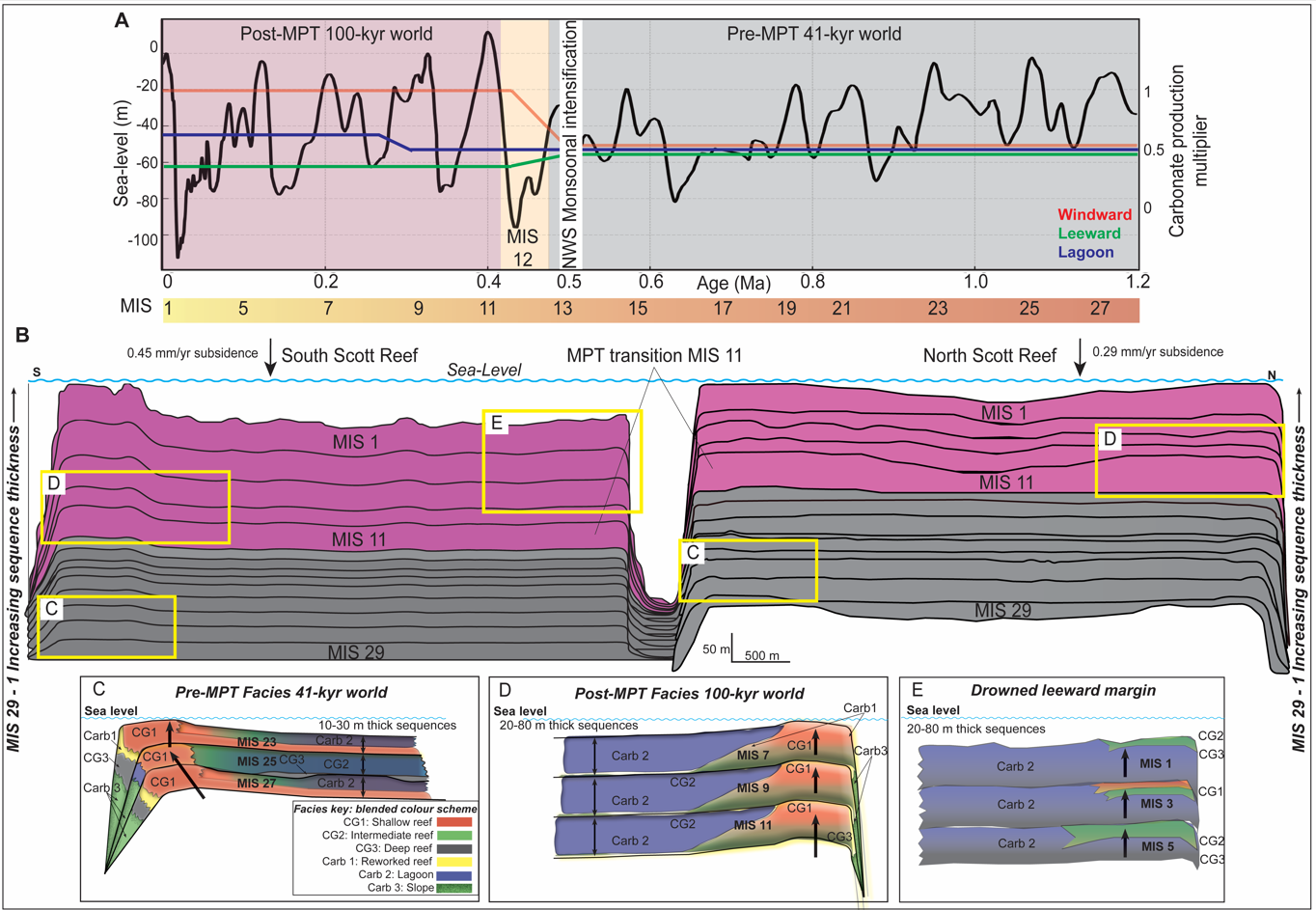
Conceptual sketch of the MPT model (1.2 Ma to present) simulated sequence stratigraphy of North and South Scott Reef, showing the transition from 41 kyr, pre-MPT keep-up reef sequences (10–30 m thick, progradational, shallow reef–dominated margins) (panel C), to 100 kyr post-MPT catch-up sequences (20–50 m thick, aggradational, deeper reef dominated) (panel D). The prolonged MIS 11 highstand is a major step in producing the “empty bucket” morphology and leeward margin drowning of the South Reef that is postulated to have functioned in relation to increased amplitude and reduced periodicity of sea-level cycles and increased monsoonal intensification during interglacials. The model illustrates one possible iteration of the transition from a 41 kyr cycle with 60m amplitude from 1.2 – 0.7 Ma (MIS 29-17), to a longer 100 kyr cycle with 120m amplitude, which becomes more pronounced after the MPT. This is primarily a result of increasing subsidence through time, which is contrary to the forcing of eustacy alone. Panels A-D show detailed facies responses to the sea-level oscillations of the pre-MPT and post-MPT world, respectively. Panel E illustrates the give-up reef on the drowned leeward margin of South Scott Reef post-MPT due to decreased carbonate production and increased water depth.
#MarineScienceSydneyUni
Read the full paper: Marine Geology, 493, Article 107716
https://doi.org/10.1016/j.margeo.2026.107716
 Geocoastal Research Group