
 Please join me in congratulating GRG collaborator Ulysse Lebrec and the team on the publication of a new paper in the journal Quaternary Science Reviews.
Lebrec, U., Riera, R., O’Leary, M., Webster, J.M., Yokoyama, Y., Gliganic, L.A., Lang, S.C. and Paumard, V., 2023. Drilling 1100-km-long seafloor ridges reveals how palaeoshorelines control carbonate shelf morphologies (North West Shelf, Australia). Quaternary Science Reviews, 312. https://doi.org/10.1016/j.quascirev.2023.108164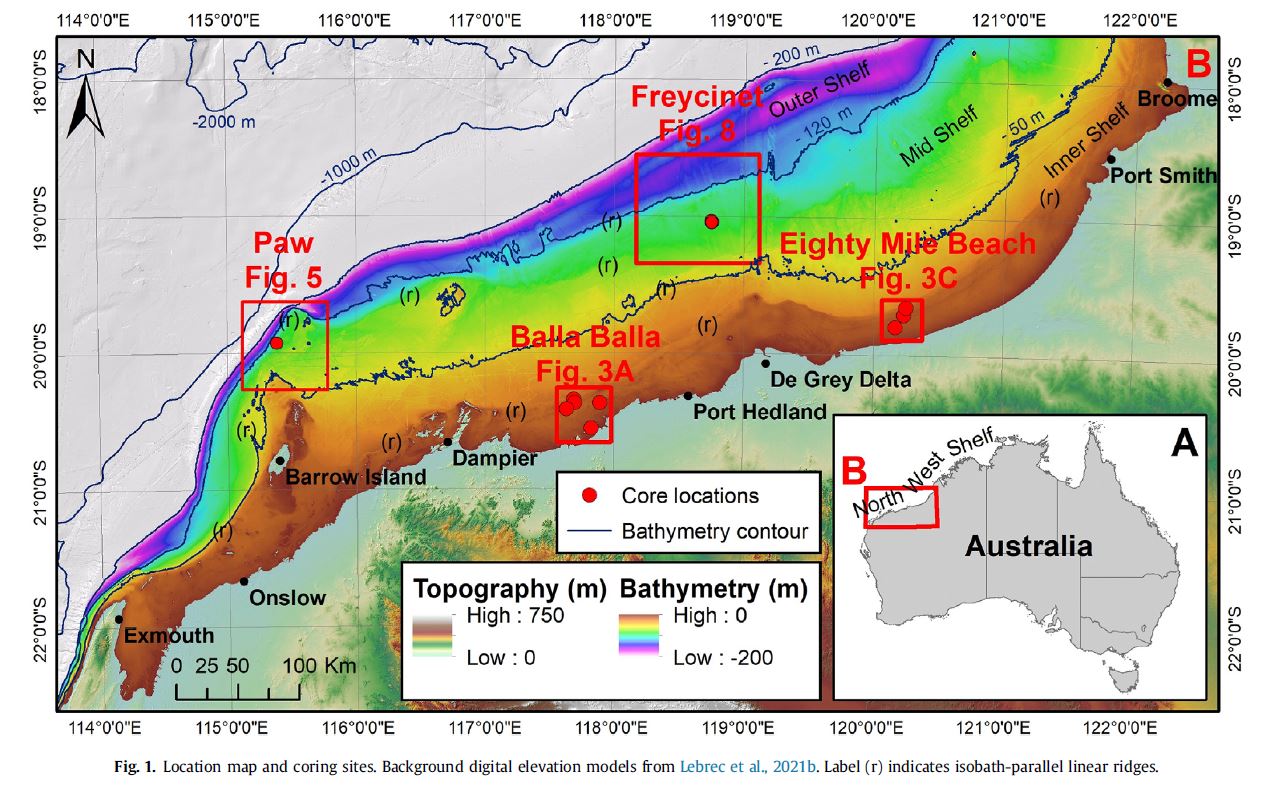
Highlights
- The NWS (Australia) is covered with linear ridges that can be tracked over 1100 km.
- These ridges are interpreted as palaeoshorelines from borehole and geophysical data.
- They are formed by coastal processes and preserved through early diagenesis.
- Relict coastal features control the continental shelf morphologies and coral-reef distribution.
Abstract
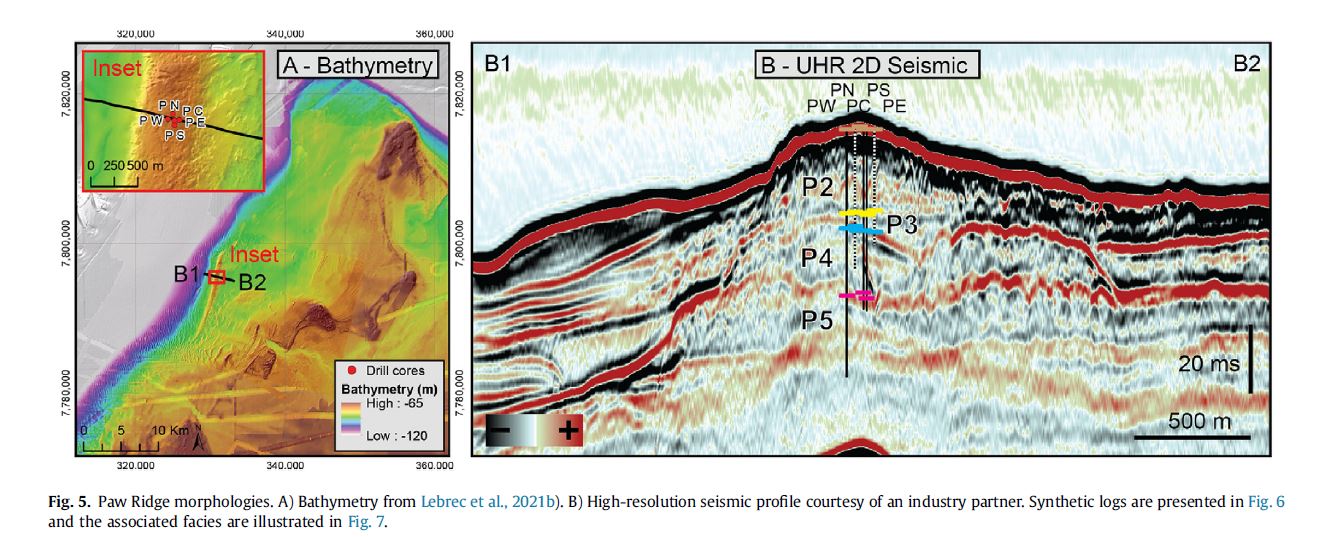
The Rowley Shelf, the southern half of the tropical, carbonate-dominated, North West Shelf of Australia, is covered with linear ridges that can be tracked parallel to the coast over 1100 km between the modern coast and the 140 m isobath. Here, we investigate the origin and nature of these ridges based on the integration of extensive borehole data, high-resolution geophysical data, age dating and compaction analysis.
Our investigation reveals that each ridge consists of now-submerged relict coastal deposits that were formed over the last 200,000 years through wave, tidal, fluvial and aeolian processes. These features were dominantly preserved through early diagenesis and illustrate the longest continuous submerged palaeoshorelines reported to date.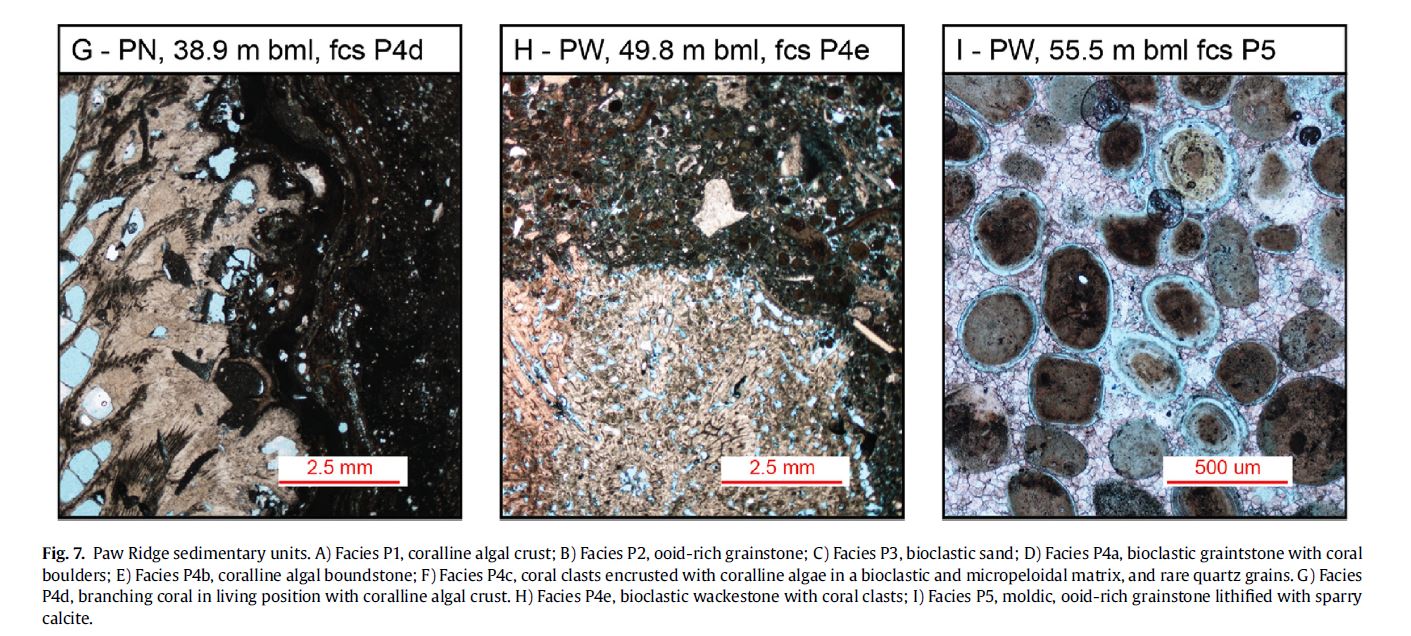
The distribution of relict coastal features, and therefore early diagenesis, controls the morphology of the continental shelf. First, relict coastal features tend to be stacked on top of each other, resulting in the formation of composite diachronous coastal deposits that form distinctive steps on the seabed, up to 10s m high. Second, relict coastal features form a hard substrate that controls the location of coral reefs along the shelf. Reefs, including a 20-m-thick MIS 3 drowned coral reef described here for the first time, as well as modern reefs of the Muiron Islands, Montebello Islands and Dampier Archipelago, are all developed on top of relict coastal features.
The distribution, size and mineralogy of relict coastal features highlight climatic changes along the Rowley Shelf. High relative sea levels (RSL) are associated with low carbonate production and up to 50% of terrigenous grains, while low RSL deposits exhibit increased carbonate production and reduced terrigenous grain content. This asymmetry is interpreted to reflect the onset of the monsoon associated with increased fluvial runoffs during interglacial periods.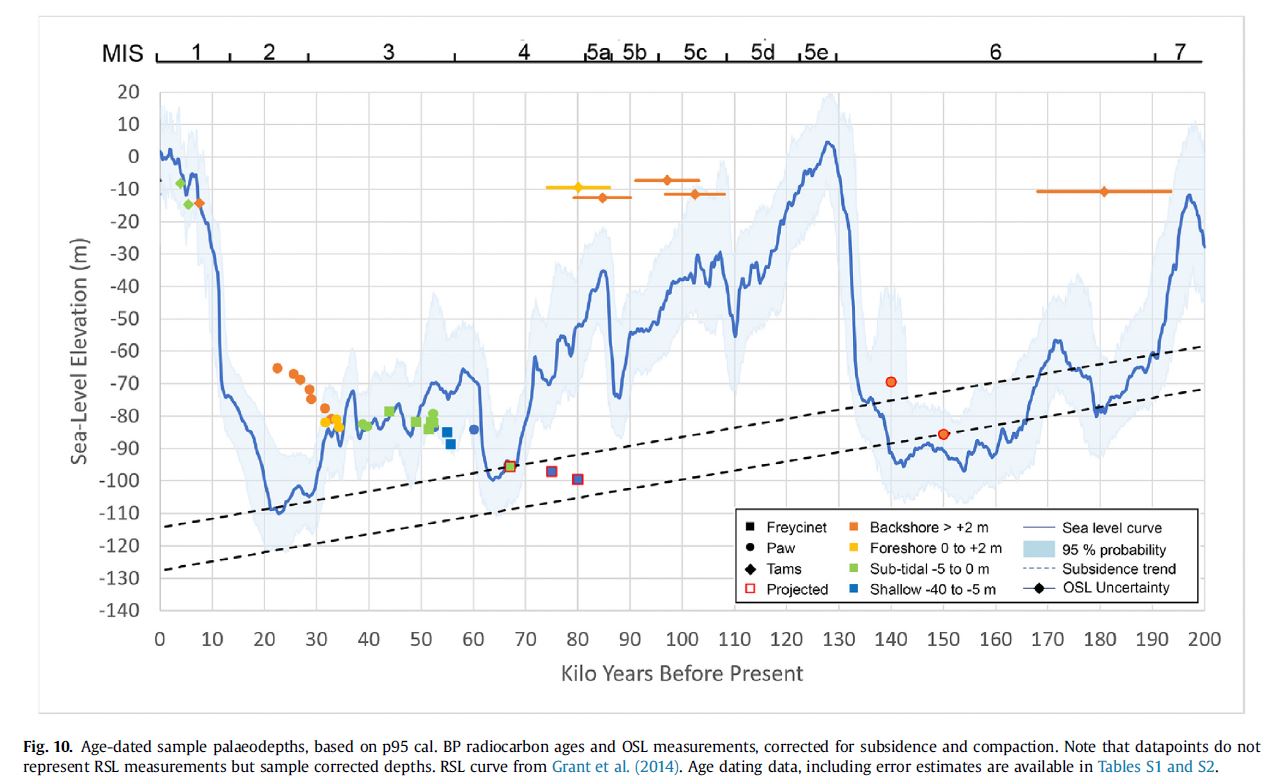
Lastly, our work shows that compaction analyses are critical for palaeoenvironment and RSL reconstructions. Indeed, the accumulation of 50 m of sediment on a RSL indicator can result in an offset of the measurement by 12.7 m.
This study represent another contribution from an exciting new program of collaboration between the University of Sydney, University of Western Australia and the University of Tokyo.
Cheers
Jody
#MarineScienceSydneyUni
 Geocoastal Research Group