

Please join me in congratulating of GRG collaborator Dr Jesus Reolid (University of Granada, Spain) on the publication of his new paper in the journal Coral Reefs.
Reolid, J., Bialik, O. M., Lindhorst, S., Eisermann, J. O., Petrovic, A., Hincke, C., Beaman, R. J., Webster, J. M.,and Betzler, C., 2024, A new type of Halimeda bioherm on the Queensland Plateau, NE Australia: Coral Reefs. This paper is Open Access so feel free to download it directly here.
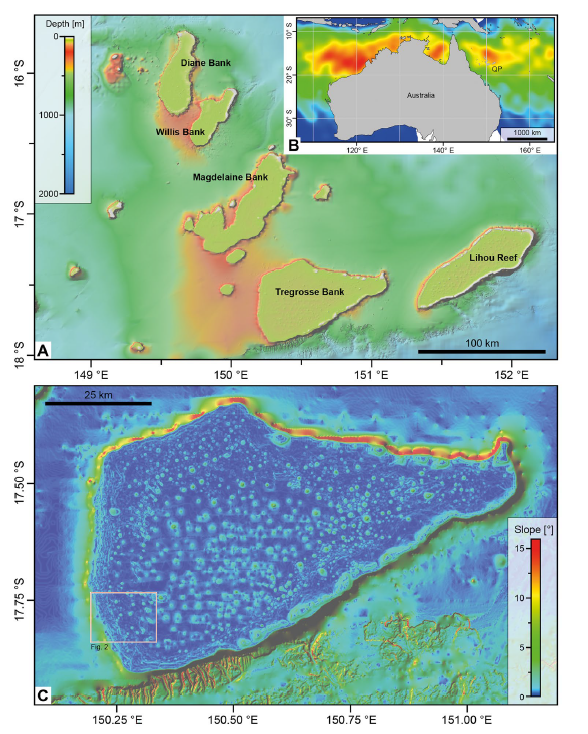

The paper presents a comprehensive analysis of newly collected high-resolution marine geophysical data (multbeam bathymetry, sub-bottom profiles, high-resolution sea floor imagery, and discrete sediment samples) collected during the RV Sonne Cruise (SO292) in 2022 to investigate the evolution and partial drowning of the Queensland Plateau, off the North Eastern Australian margin, as well as the modern deep water habitats and benthic communities.
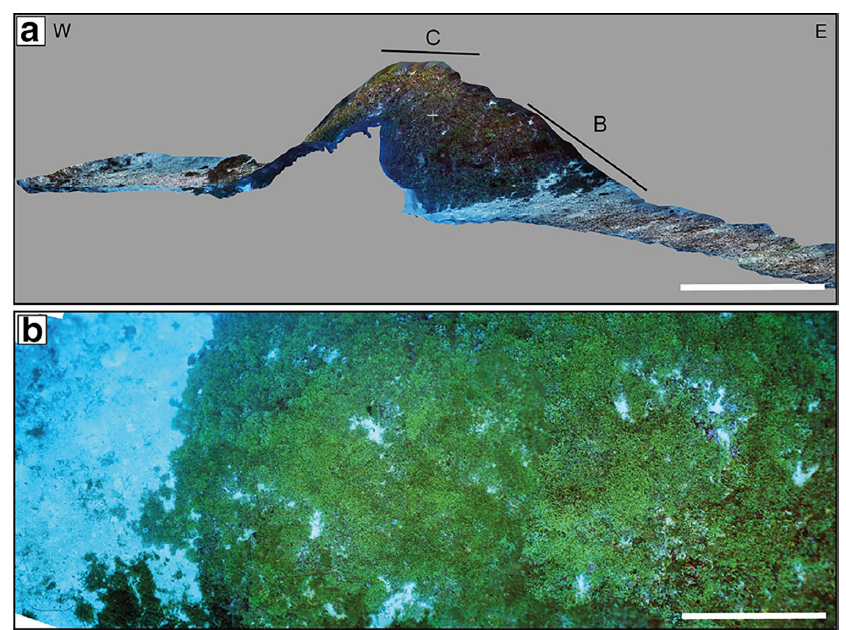
On this research expedition we discovered extensive Halimeda (green calcareous algae) buildups forming cone-like mounds up to 500 m in diameter and 3–10 m high, with gentle slopes (2°–5° on the top of Tregrosse Bank). The bioherms occur in water depths of 10–70 m, with most bioherm between 50 and 65 m. Their internal structure consists of aggrading low-amplitude reflections at the core of the bioherm interfingering with high-amplitude reflections to the flanks. Surface facies distribution displays one to four facies belts, from distal to proximal: Halimeda rudstone, Halimeda rudstone with living plants, Halimeda Rudstone with coralgal debris, and coralgal boundstone (when present, occupied the top of the bioherms).


These observations suggest that the buildups on the Queensland Plateau reefs represent a new Halimeda bioherm morphotype, distinct from previously described bioherms on the adjacent Great Barrier Reef (see our HALO project for recent discoveries) and elsewhere globally.
This study also represents another step in an exciting program of collaboration between the University of Sydney and numerous national and international partners working together on a wealth of new data collected on recent research cruises on the RV Sonne (German DFG) and RV Falkor (Schmidt Ocean Institute) to investigate long term carbonate platform evolution, submarine landslides, and modern mesophotic reefs and the deeper water, unexplored seascapes of the Coral Sea.
Bravo Jesus and the team!
Cheers
Jody
#MarineScienceSydneyUni
 Geocoastal Research Group