
Williams, C., Webster, J.M., Bevitt, J.J., Webb, G.E., Nothdurft, L.D., Paumard, V., McGregor, H., and Murphy, R.J., 2025, Neutron computed tomography: A novel high-resolution, non-destructive method for screening fossil coral for diagenetic alteration for geochronologic and paleoclimatic reconstructions: Geochemistry, Geophysics, Geosystems, v. 26, e2025GC012439, https://doi.org/10.1029/2025GC012439
The work has also been featured in a University of Sydney news story: https://www.sydney.edu.au/news-opinion/news/2025/10/08/neutron-scanning-coral-fossils-reveals-climate-history.html
Fossil corals are important archives of past sea-level and climate, but their diagenetic alteration over time make them unreliable in paleoclimatic and paleochronologic reconstructions. This paper introduces a new method using neutron computed tomography (NCT) to find hidden sections of well-preserved aragonite within fossil coral skeletons that can be used for dating and paleoclimate studies without destroying the sample. A key advantage of NCT is its ability to map hydrogen content, providing a reliable indicator for identifying regions of well‐preserved skeletal aragonite, since aragonite typically retains more water organic‐matter than calcite.
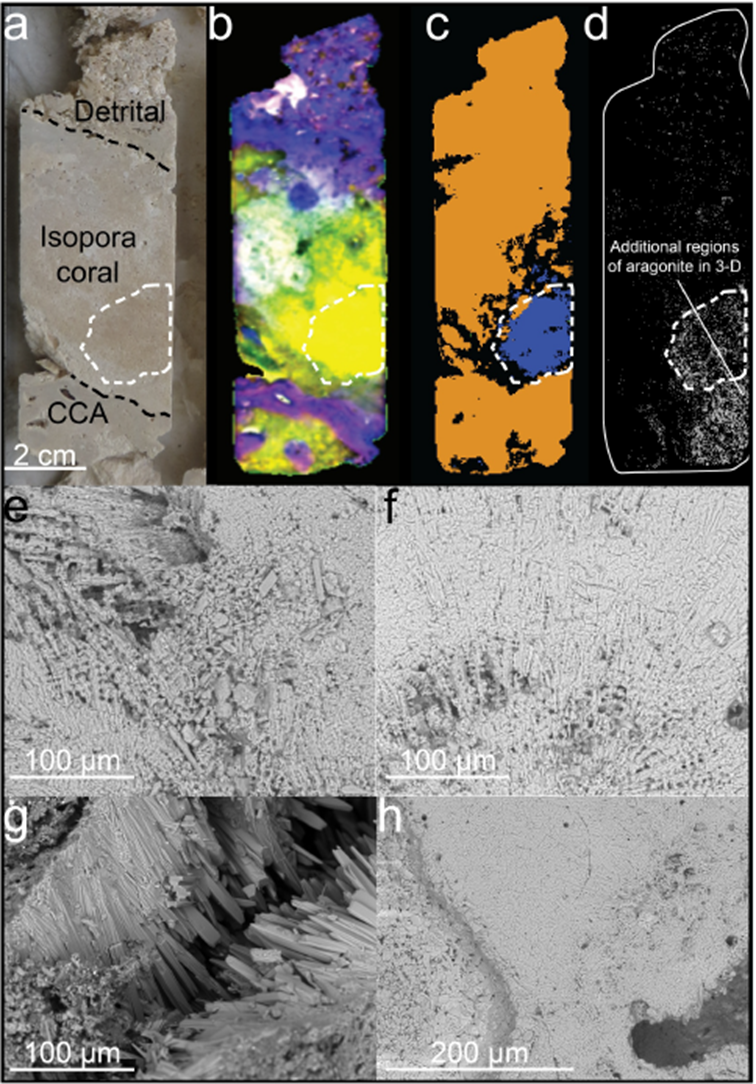
Fig. 1 Williams et al., 2025 – G-Cubed: Neutron Computed Tomography (NCT) reveals previously undetected regions of aragonite in 3-D (d), confirmed by SEM (e, f), that were not identified by traditional screening methods such as hyperspectral scanning (c).
Key findings of the paper include:
- Detailed reconstructions of diagenetic histories in fossil coral reefs are essential for their selection for further geochronologic and paleoclimatic studies. This study shows that NCT scans successfully distinguish between coral aragonite and calcite by mapping their 3‐D distributions in diagenetically altered fossil corals. With high sensitivity to H content, NCT is an ideal tool for screening well‐preserved coral aragonite and also captures sub-mm core features, such as seasonal growth banding and 3‐D structure of coral skeletons, offering detailed insights at representative scales.
- As a high resolution, non‐destructive method, NCT reduces sampling time and potentially costs (commercial rates at $9,299/day, and free for academic, merit‐based access), while simplifying screening for secondary carbonate mineral replacement, making it a valuable tool for screening diagenetically complex fossil coral reef samples.
- NCT scans have been shown to complement and corroborate existing pre-screening methods (XRD, SEM, thin section analysis, hyperspectral imagery and X‐Ray CT) based on diagenetic screening of three fossil coral samples of various ages, genera and growth morphologies. In a highly altered fossil coral sample, NCT successfully identified the remaining aragonite that other 2‐D and 1‐D methods missed.
- Comparing NCT histogram values with petrographic and geochemical analyses showed that neutron attenuation reflects a range of primary carbonate mineral alteration, thereby providing the potential for improved diagenetic screening.
Looking Ahead
Finally, specific recommendations are provided for future users on how to apply this technique for diagenetic screening of other fossil coral samples, emphasizing the need for standardized acquisition parameters and the integration of complementary screening techniques to improve the reliability of geochronologic and paleoclimatic reconstructions.
Read the full open-access article here: https://doi.org/10.1029/2025GC012439
 Geocoastal Research Group