
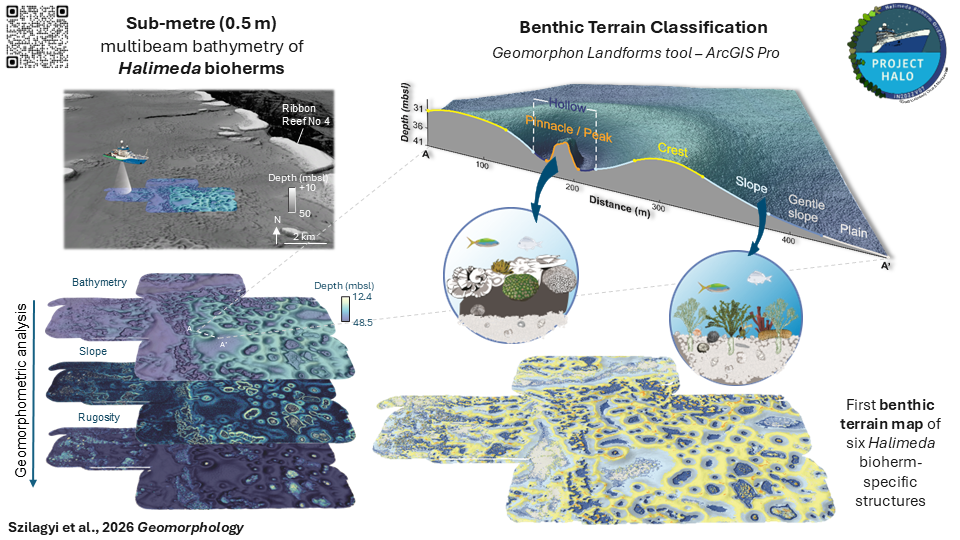
Please join me in congratulating of GRG member Zsanett Szilàgyi on the publication of her fantastic new paper in the journal Geomorphology.
Szilagyi, Zs., Nothdurft, L., Duce, S., Webster, J. M., McNeil, M., Beaman, R. J., Braga, J. C., Graham, T., Byrne, M., Nau, A., Berry, C., Paumard, V., Shragge, J., Kim, C., Bostock, H., 2026. High-Resolution mapping and terrain classification of Halimeda bioherms in the northern Great Barrier Reef. Geomorphology. https://doi.org/10.1016/j.geomorph.2026.110243
Some highlights from the paper include:
- Investigation of Halimeda bioherms in unprecedented detail using the first sub-meter resolution multibeam bathymetry over three sites in the northern GBR.
- Bioherms show crest-hollow-pinnacle architectures with fine-scale heterogeneity.
- Identified slope asymmetries and E-W depressions likely indicate hydrodynamic influence on bioherm’s growth while S to N shallowing pattern reflects changes in antecedent surfaces and flooding history.
- Benthic terrain classification for the first-time over the bioherms using a novel approach as a new framework for habitat mapping and management.
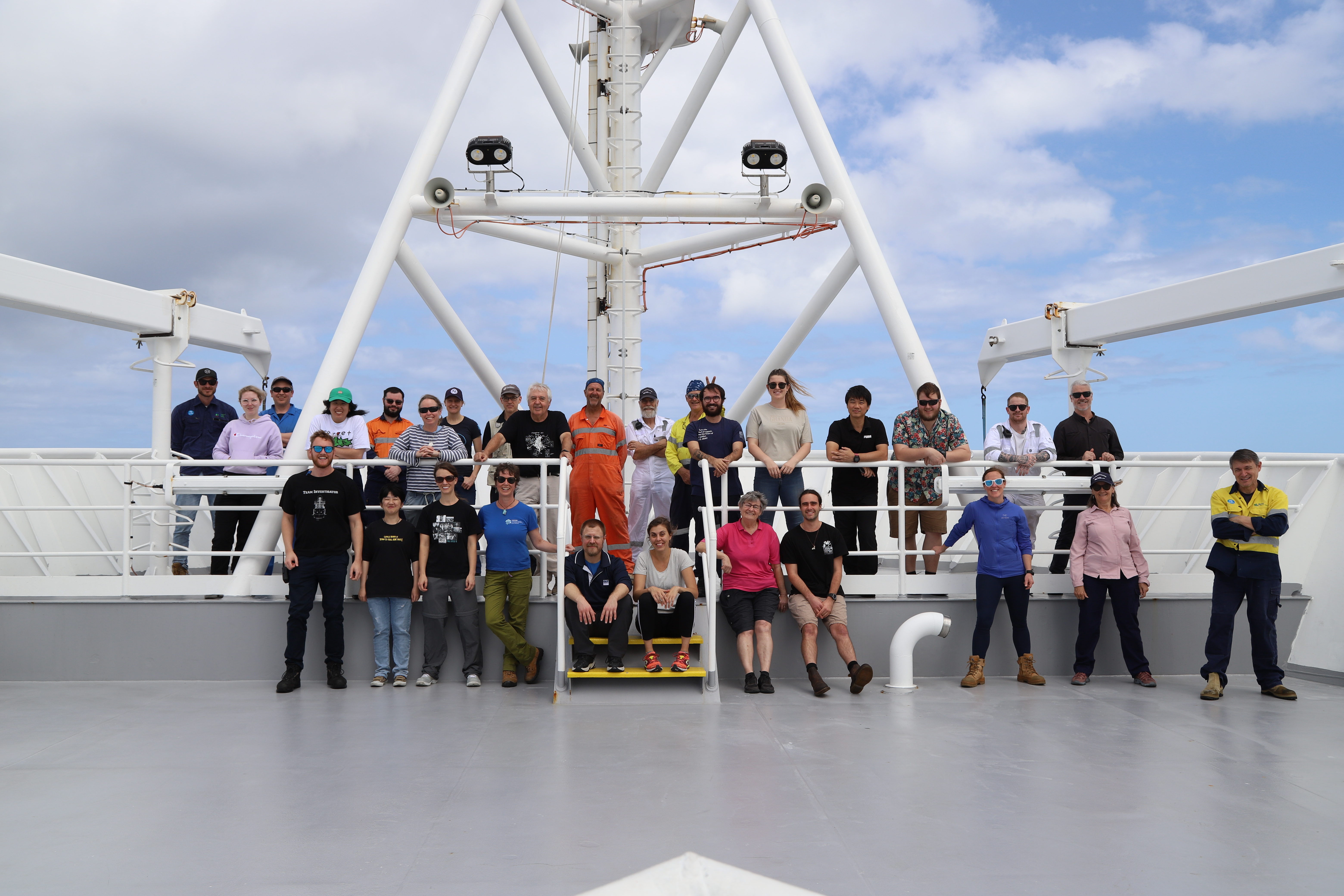
This new paper from Project HALO takes a deep dive into the enigmatic Halimeda bioherms of the northern Great Barrier Reef. Using sub-metre resolution multibeam bathymetry collected aboard R/V Investigator, we were able to map these vast inter-reef carbonate structures in unprecedented detail.
The results reveal that these features are far more intricate than previously thought; with donut-like rings, internal hollows, pinnacles and large depressions forming a remarkably complex seafloor landscape. By combining high-resolution mapping with geomorphometric analysis and benthic terrain classification, the study sheds new light on how these bioherms form and evolve, and provides a framework for future habitat mapping and paleo-environmental research across this enormous (>6000 km²) ecosystem of the northern Great Barrier Reef.
Bravo Zsanett and we would also like to acknowledge the fantastic contributions of our co-authors and the entire HALO science team on this great collaborative effort.
Cheers,
Jody
#MarineScienceSydneyUni
 Geocoastal Research Group