
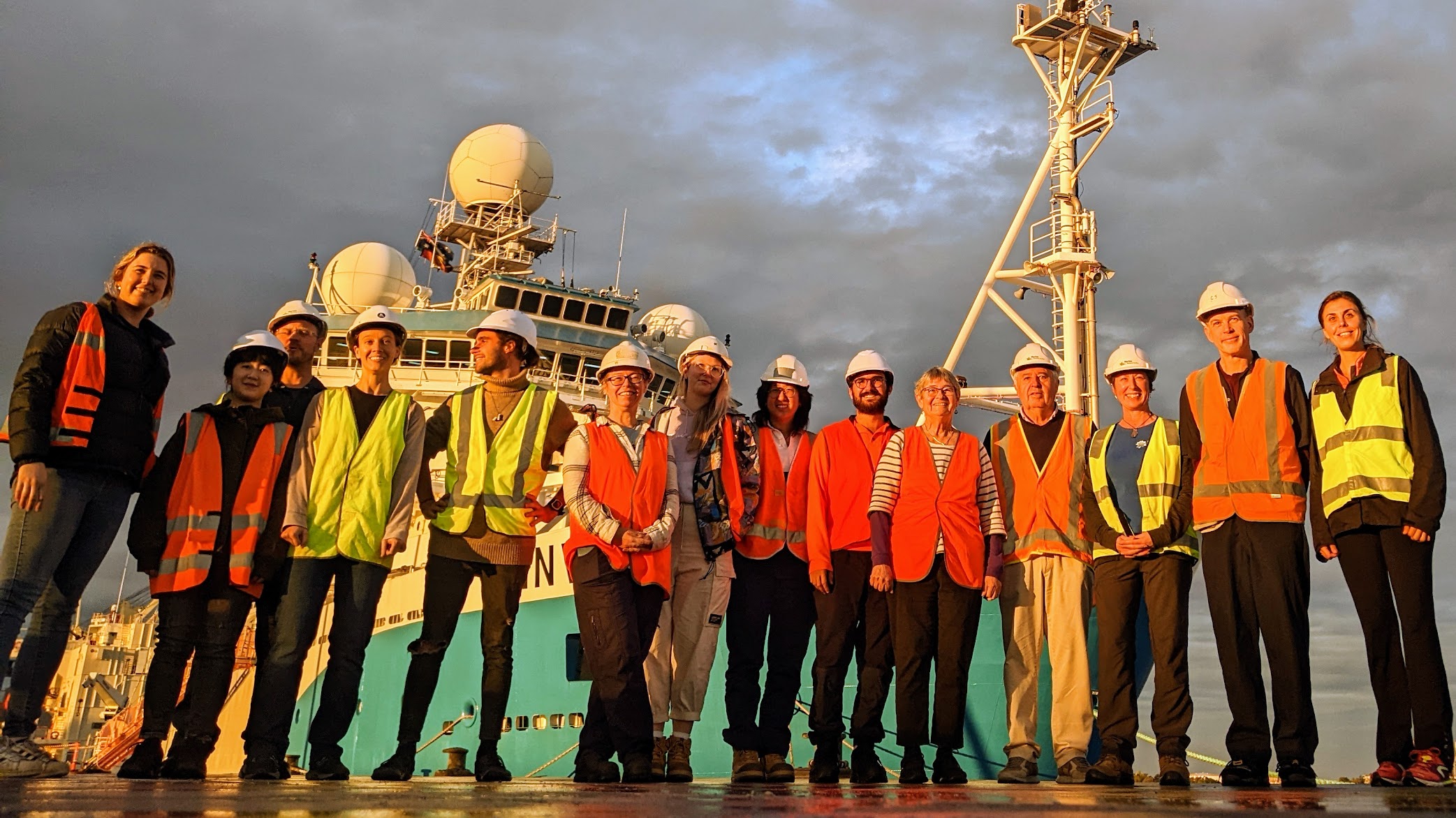
The offshore HALO science team Aug-Sep 2022 (image credit: Luke Nothdurft)
Please find below our new
Science Update article published the science news magazine
EOS.
Webster, J.M., McNeil, M.A., Bostock, H., Nothdurft, L. and Byrne, M.N., 2023. Making sense of the Great Barrier Reef’s mysterious green donuts.
EOS.
https://doi.org/10.1029/2023EO230079
This short article summarises some of the highlights from our recent
RV Investigator voyage to the GBR to investigate the amazing Halimeda bioherms, as well as the exciting promise of what we hope to achieve with the post voyage scientific work. Many thanks to the entire HALO science team, Marine National Facility (MNF) staff and
RV Investigator crew who supported the voyage.
7/11/2022
Important HALO update: Following our recent CSIRO
RV Investigator voyage to investigate the
Halimeda bioherms in the northern Great Barrier Reef, I wanted to acknowledge the amazing contributions from entire HALO science team – both offshore & shore-based – that contributed to it’s great
success. The entire team looks forward now to diving into the post cruise science objectives.
To the wider scientific community, if you’re interested in being part of this collaborative project please don’t hesitate to reach out.
Jody
#MarineScienceSydneyUni
HALO Science team members
| Name |
Institution |
Offshore/Shore-based |
| Jody Webster |
USYD |
Offshore |
| Maria Byrne |
USYD |
Offshore |
| Matthew Clements |
USYD |
Offshore |
| Monique Webb |
USYD |
Offshore |
| Luke Nothdurft |
QUT |
Offshore |
| Zsanett Szilagyi |
QUT |
Offshore |
| Trevor Graham |
QUT |
Offshore |
| Robin Beaman |
JCU |
Shore-based |
| Stefano Borghi |
JCU |
Offshore |
| Tom Bridge |
JCU/Qld Museum |
Shore-based |
| Helen Bostock |
UQ |
Offshore |
| Kimberley Chua |
UQ |
Offshore |
| Molly Husdell |
UQ |
Offshore |
| Patrick Moss |
UQ |
Shore-based |
| Darren Skene |
Quaternary Resources |
Offshore |
| Mardi McNeil |
Geosciences Australia |
Offshore |
| Juan Carlos Braga |
Universidad de Granada |
Offshore |
| Angel Puga-Bernabeu |
Universidad de Granada |
Shore-based |
| Bethany Behrens |
University of Tokyo |
Offshore |
| Yuning Zeng |
University of Tokyo |
Offshore |
| Yusuke Yokoyama |
University of Tokyo |
Shore-based |
| Dirk Erler |
Southern Cross University |
Shore-based |
| Willem Renema |
Naturalis, Biodiversity Center |
Shore-based |
| Pat Hutchings |
Australian National Museum |
Shore-based |
| Matthew Kosnik |
Macquarie University |
Shore-based |
| Carra Williams |
USYD |
Shore-based |
| Victorien Paumard |
UWA |
Shore-based |
| Juliet Sefton |
Monash University |
Shore-based |
| Jeffrey Shragge |
Colorado School of Mines |
Shore-based |
Jun 23, 2018
Hi all, it gives me great pleasure to announce that we have been officially awarded an
RV Investigator voyage to study the
Halimeda (green calcareous algae) build-ups in the Great Barrier Reef (project details below).

After McNeil, M. A., Webster, J. M., Beaman, R. J., and Graham, T. L., 2016, New constraints on the spatial distribution and morphology of the Halimeda bioherms of the Great Barrier Reef, Australia: Coral Reefs.
With colleagues from JCU, QUT, UQ, Queensland Museum and overseas, we have been awarded 33 days of shiptime in 2020 from the
Marine National Facility.
Important update: Due to COVID-19 the Marine National Facility has now rescheduled this voyage for ~Aug-Sep 2022. This is positive news and voyage planning is well advanced and on track for this new schedule.
Project summary:
Calcareous green alga
Halimeda is a major contributor to coral reef shelf sediments and is found along the entire GBR. Previous studies of extensive
Halimeda deposits, or bioherms, show they represent important inter-reef habitats and potential carbon sinks in the GBR Marine Park, covering about 26% of the northern shelf area, at least equal to the modern coral reef system. Pioneering work in 70-80s using widely-spaced, singlebeam and seismic profiles indicate the bioherms are in depths of ~20-40 m and form linear ridges and flat-topped mounds up to 20 m thick. However, new bathymetry data reveals a completely different picture of their surface morphology; characterised by complex reticulate (honeycomb-like) shapes and cyclical internal reflectors continuous over 100s of m. These new findings suggest
Halimeda bioherms are more complex than previously thought – challenging existing paradigms describing their origin, development and significance.

Day Reef bioherm (Credit: Emma Kennedy)
We will conduct high-resolution multibeam swath mapping and sub-bottom profiling, in conjunction with autonomous and remotely operated underwater vehicles (AUVs, ASV, ROV) seabed imaging, and sediment coring at strategic locations. Key scientific objectives of
HALO are to:
1) Define the spatial distribution and morphological variation of the
Halimeda bioherms;
2) Explore the relationship of the bioherms to the undersea landscape (channels, passages and submarine canyons) and key oceanographic processes;
3) Develop new 3D models explaining their origin and development, generate Holocene paleo-climate data, including novel archives of upwelling, paleo-flooding and water quality;
4) Quantify their total volume/area as a regional geological carbon sink within the context of the global carbon budget; and
5) Assess the importance of the bioherms as modern, inter-reef benthic habitats.
This research will increase our fundamental understanding of the processes that control bioherm development, and have direct implications for environmental managers tasked with predicting how these poorly studied inter-reef environments might respond to future climate change.
Exciting times ahead.
Cheers
Jody
#MarineScienceSydneyUni



 Geocoastal Research Group
Pingback: Fully funded PhD projects now available with the Geocoastal Research Group!! | Geocoastal Research Group·
Pingback: Fully funded PhD projects now available with the Geocoastal Research Group!! | Geocoastal Research Group·
Pingback: Hot off the press! Variations in Mid‐ to Late Holocene Nitrogen Supply to Northern Great Barrier Reef Halimeda Macroalgal Bioherms | Geocoastal Research Group·
Pingback: Hot off the press! Evolution of the inter-reef Halimeda carbonate factory in response to Holocene sea-level and environmental change in the Great Barrier Reef | Geocoastal Research Group·
Pingback: Hot off the press! Ooids, paleo-tides & sea level changes in the southern Great Barrier Reef | Geocoastal Research Group·
Pingback: Making Sense of the Great Barrier Reef’s Mysterious Green Donuts – Androidizer·
Pingback: Making Sense of the Great Barrier Reef’s Mysterious Green Donuts – Busy Bees Journal·
Pingback: Hot off the press! Making Sense of the Great Barrier Reef’s Mysterious Green Donuts. | Geocoastal Research Group·
Pingback: Making Sense of the Nice Barrier Reef’s Mysterious Inexperienced Donuts - phungo·
Pingback: Making Sense of the Nice Barrier Reef’s Mysterious Inexperienced Donuts - phungo·
Pingback: Making Sense of the Nice Barrier Reef’s Mysterious Inexperienced Donuts - phungo·
Pingback: Making Sense of the Nice Barrier Reef’s Mysterious Inexperienced Donuts - phungo·
Pingback: Hot off the press! Extensive Halimeda (green calcareous algae) bioherm deposits discovered in the Coral Sea | Geocoastal Research Group·