
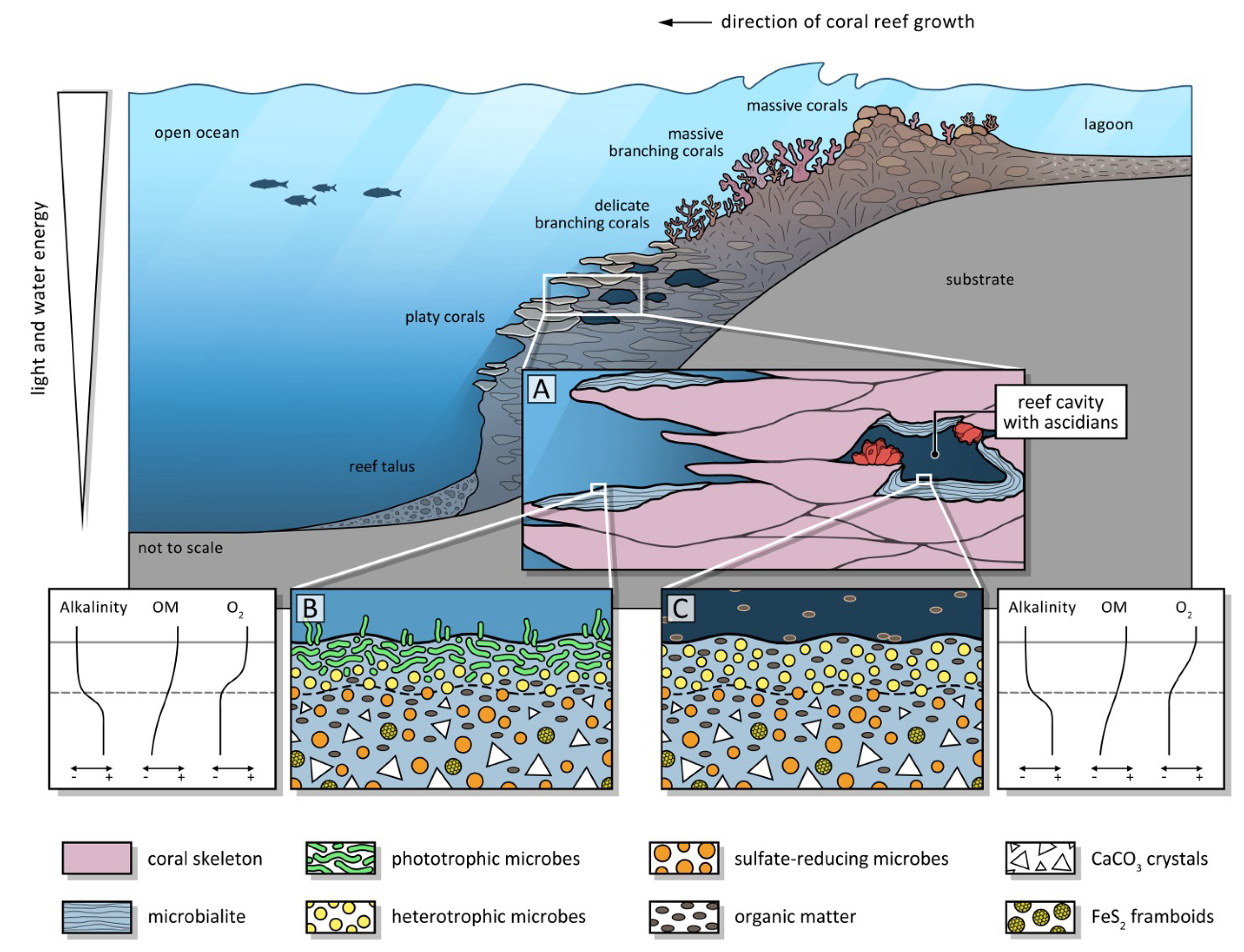
Please join me in congratulating GRG collaborator Professor Hildegard Westphal and the international team on their new paper in Biogeosciences, which reports the first direct evidence for light-dependent microbial mat communities in Pleistocene drowned reefs from IODP Expedition 389 Hawaiian Drowned Reefs.
Westphal, H., Garuglieri, E., Webb, G. E., Nothdurft, L., Merkel, A., Khanna, P., Karki, P., Nohl, T., Gischler, E., Webster, J. M. 2026. Biosignatures of microbial mats in Pleistocene coral reef cores from IODP Expedition 389 (Hawaiian Drowned Reefs). EGUsphere. https://doi.org/10.5194/egusphere-2026-1564
The study examined microbialite crusts preserved within reef cores recovered from the H2 terrace around the Island of Hawai‘i. These crusts, up to 20 cm thick, formed within coral reef frameworks during Marine Isotope Stages 7–6, approximately 130,000–225,000 years ago.
Using scanning electron microscopy, the team identified exceptionally well-preserved evidence of calcified extracellular polymeric substances, microbial filaments and coccoid structures resembling cyanobacteria. Samples from the humid, windward side of Hawai‘i preserved the clearest evidence, while microbialites from the arid, leeward side showed more cryptic peloidal fabrics and fewer recognisable biological structures.
The key findings include:
- First direct evidence that cyanobacteria contributed to microbialite formation in Pleistocene Hawaiian reefs;
- Evidence for microbial mats forming in shaded but still light-penetrated reef settings;
- Pyrite framboids and mineral textures indicating strong redox gradients and the activity of sulphate-reducing and other heterotrophic microbes beneath the mat surface; and
- Clear differences between windward and leeward reef settings, highlighting the influence of rainfall, runoff, nutrients and local environment.
These beautifully preserved microbial biosignatures show that reefal microbialites are not simply passive cements, but sensitive archives of reef ecology, microbial diversity and environmental change.
The paper is also an exciting early demonstration of the scientific potential of Expedition 389 and the remarkable quality of the recovered Hawaiian reef cores.
Congratulations to Hildegard and the rest of the team and watch this space for more exciting X389 scientific results coming soon.
Cheers
Jody
#MarineScienceSydneyUni

